How to Bill Clients for Horse Show Expenses
2026-11-20 · James Dexter, founder and CEO of STABLE Pro Technologies. He also operates Fifty Horse Ranch in Fallon, Nevada, which runs on STABLE Pro.

Day fees, hauling, splits and entries. How trainers bill horse show expenses, split shared costs fairly and get paid before the trailer leaves.
Published by STABLE Pro Technologies, Inc.
The short answer
Tell clients what a show will cost before you go. Take a deposit. Split the shared costs by a rule everyone knows. Then send the bill within a few days of getting home, with every charge on its own line.
Show bills are harder than board bills. They're bigger, they're different every time, and half the charges come from the show office, the hotel and the fuel pump, not from you. The fix is the same as any bill. No surprises, and nothing to guess at.
What goes on a show bill
Most show bills come down to five kinds of charges.
The trainer's day fee. This pays for the trainer's time and the extra work of being on the road. What it covers changes from barn to barn. Ohio trainers Judd and Jennifer Paul of IronGate Quarter Horses told Equine Chronicle their day fees usually cover things like grooming and stable supplies and part of the staff's meals. Some trainers charge coaching, schooling rides and grooming separately. Whatever yours covers, write it down.
Show office charges. Entries, stall fees, office fees, association fees. These are usually per horse and easy to assign.
Shared horse costs. Tack stall, grooming stall, feed, shavings, night watch. One stall or one bale serves several horses, so these get split.
Shared people costs. The trainer's hotel, meals and travel. These get split too, usually a different way. More on that below.
Hauling. Mileage or a flat rate per trip. California trainers David and Cheryl Busick told Equine Chronicle that most of these billed items are money passed straight through, with hauling the one place they might make anything.
One line per charge, one horse per line, and the date. A client should be able to look at the bill and match every line to something that happened.
Splitting shared costs
This is where show bills start arguments. Pick a rule, write it down, and use it every time.
A common rule, and one you'll see show riders describe again and again on the Chronicle of the Horse forums, goes like this:
- Horse costs split by horse. Tack stall, grooming stall, feed, shavings. A client with three horses uses more of the tack stall than a client with one.
- People costs split by rider. The trainer's hotel, meals and travel. The trainer's room costs the same whether you brought one horse or three.
- Hauling split by horse on the trailer. Missouri trainer Jimmy Miller split hauling by the number of horses on the van, according to Stable Management.
Here's how that plays out on a made-up weekend. Four horses go, owned by three riders. The tack stall is $300. The trainer's hotel is $600.
| Rider | Horses | Tack stall share | Hotel share | Total split |
|---|---|---|---|---|
| Ann | 2 | $150 | $200 | $350 |
| Ben | 1 | $75 | $200 | $275 |
| Carla | 1 | $75 | $200 | $275 |
| Total | 4 | $300 | $600 | $900 |
Two more things to decide ahead of time:
- The trainer's own horse. If you take your own horse to the show, say whether it's in the splits. Clients who find out after the fact that they paid part of the trainer's stall don't forget it.
- Let the show office do some of the work. Bookkeeper Pamela Saul suggests in The Plaid Horse asking show management to put split charges like night watch or a tack room straight onto each client's account, so clients pay their share directly.
Get paid before the trailer leaves
A show weekend can run into the thousands. If you front all of it and bill later, you're the bank. A few ways around that:
Hand out your show prices in writing. Many trainers give new clients a printed sheet of show costs, Stable Management reports, and some write a coaching fee clause into the contract. Arabian trainer Deborah Johnson, just down the road from us in Minden, Nevada, gave clients a written fee schedule at a goal meeting each January, according to an older Stable Management piece. Colorado trainer Karen Banister did the same with handouts at a February barn meeting. Clients knew the numbers before the season started.
Take a deposit. Saul's advice is to estimate what the show will cost and collect it before you go. If billing runs late after a long weekend, most of it is already paid.
Keep a card on file. Attorney Jordan Willette told NRHA Pro Trainer that a card on file, with written permission in the contract to charge it, is one way to protect yourself.
Let clients pay some things directly. Willette also suggests having clients pay show expenses directly, so you stay out of the middle. Money you never touch is money you never have to chase.
Bill fast after the show
The longer a show bill waits, the worse it gets.
Saul has seen it happen in busy summers. Billing slides down the list, and when the invoice finally goes out it has three shows' worth of charges on it. Clients look at one big number and decide it's too high, even when every line is right.
A few habits that help:
- Write on the receipt. Saul's tip is to put a note on each receipt the moment you get it. Which horse, which client, what it was for.
- Close out with the show office. Get the full itemized statement before you leave the grounds.
- Bill one show at a time. Send it within a few days of getting home, while everyone still remembers the weekend.
- Show the split. If a line is a share of something, say so. "Tack stall, 1 of 4 horses, $75" answers the question before it's asked.
Where STABLE Pro fits
We make STABLE Pro, so read this part with that in mind.
STABLE Pro is built around the horse's profile. You select the horse, add the charge, and it's billed to that horse's owner. At a show, that means entries, day fees, overnight care and the trip itself each land on the right owner's bill, on their own lines, as detailed as you like.
You can connect your staff and let them add billing charges too, so the person at the show can enter a charge when it happens instead of handing you a pocket full of receipts on Monday. Owners can pay online, and you can preset a due date, a reminder the day before, and a percentage late fee if the bill sits.
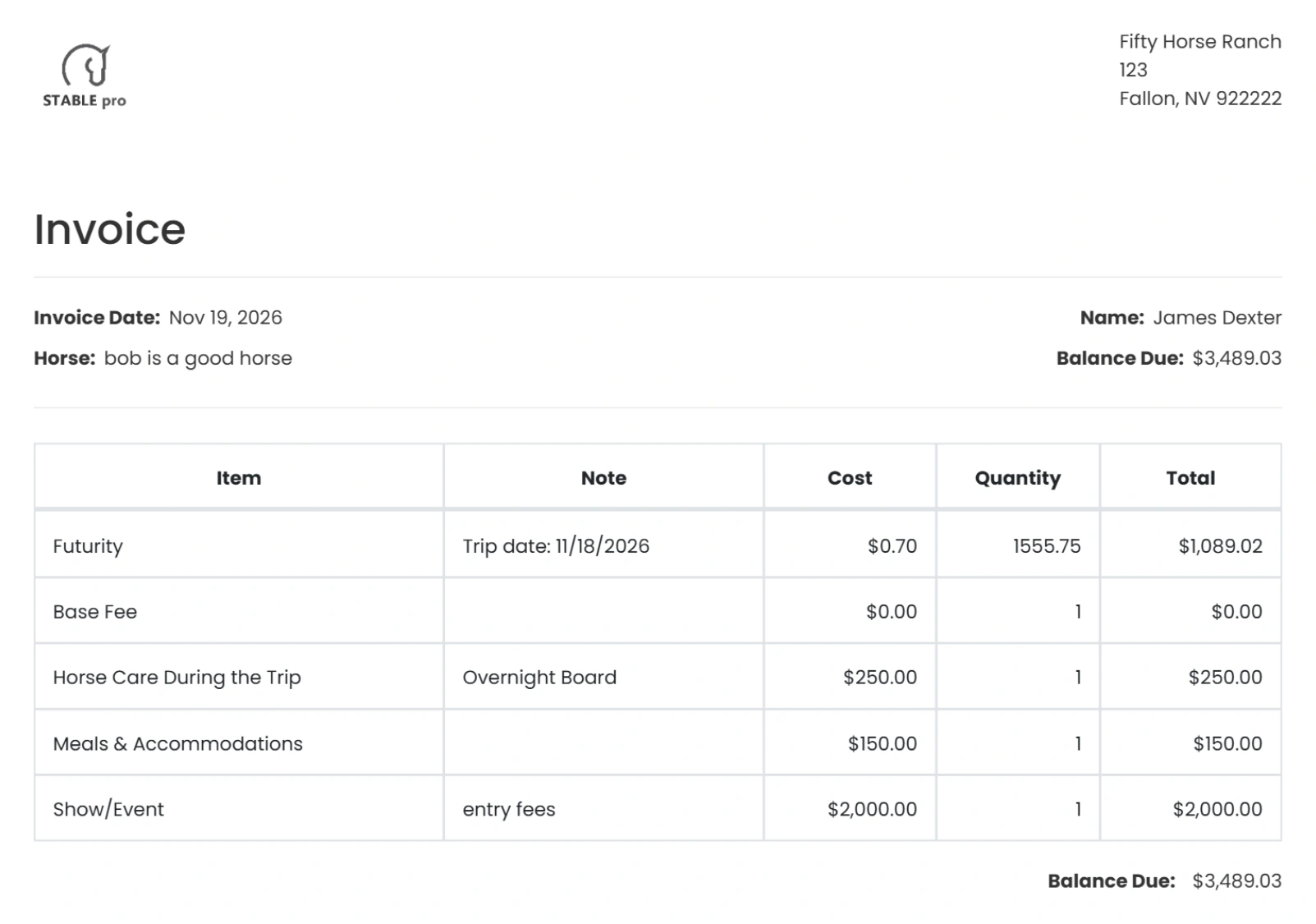
Here's a real STABLE Pro trip bill from a futurity. The trip charge, overnight board on the road, meals and lodging, and entry fees each sit on their own line, with the trip date noted and the balance due at the bottom.
App coming January 2027.
Every PRO plan comes with a 2-month free trial. Take a look at stableprotech.com.
This post is general information, not legal or tax advice. The split example uses made-up numbers. Fees and practices from the sources are examples, not current prices. Talk to an attorney about your contract terms.
Sources
- Day Fees Demystified, Delores Kuhlwein, Equine Chronicle. March 2019. Quotes IronGate Quarter Horses, Busick Quarter Horses and others.
- How trainers charge for shows, Stable Management. Quotes Deborah Johnson, Jimmy Miller, Karen Banister and others.
- Coaching fees and show costs, Stable Management.
- How to Get Paid: Addressing Cash Flow Issues Within Equestrian Businesses, Pamela N. Saul, The Plaid Horse. July 11, 2018.
- When Clients Don't Pay, Kristin Pitzer, NRHA Pro Trainer. January 29, 2025. Quotes attorney Jordan Willette.
- How does your barn divide trainer's expenses for away horse shows?, Chronicle of the Horse forum.
See it in STABLE Pro
Equine business and horse management software for professionals, equestrians and families. Explore invoicing, payments, horse records and scheduling on the official website.