How to Invoice Horse Clients for Board, Training and Extras
2026-11-19 · James Dexter, STABLE Pro Technologies

What to put on a horse invoice, the extras barns forget to bill, when to send it, and a sample invoice you can copy.
Published by STABLE Pro Technologies, Inc.
The short answer
Bill the fixed stuff ahead of time. Bill the extras as they happen. Put every charge on its own line with the horse's name, the date and what was done.
Board and monthly training are the same every month, so send them before the month starts. Extras change, so write them down the day you do them, not at the end of the month when you're trying to remember who got blanketed. Things you paid for on the owner's behalf, like a vet visit or show fees, go on as their own lines so the owner can see exactly where the money went.
A clear bill gets fewer questions, and a bill with no questions is easier to pay on time.
What belongs on a horse invoice
The basics are the same as any business. Xero's guide lists them: your business details, the client's details, an invoice number, the invoice and due dates, itemized lines, payment terms, any tax, the total, and how to pay.
A horse business needs a few more things on top of that.
- The horse's name on every line. An owner with three horses at your barn needs to know which one got the farrier.
- The date of service. "Lunge, 11/6" ends the argument before it starts.
- What was done, in plain words. "Held for farrier" beats "misc."
- Quantity and rate. Four pro rides at $50 is clearer than $200.
- Pass-through charges marked as pass-through. If you paid the vet or the show office and you're billing the owner back, say so on the line. If you add a handling fee, show it on its own line.
- Board period. Say which month the board covers, like "December board."
- Your terms. Due date, late fee, and how to pay, right on the bill.
- Tax, if it applies. Some services may be taxable where you are. Ask your tax professional whether board, training or lessons are taxable in your state, and if they are, show the tax as its own line.
The extras that get missed
Board rarely gets forgotten. The little stuff does. A short list of the usual suspects:
- Blanketing and unblanketing
- Holding a horse for the vet or farrier
- Giving meds or supplements
- A lunge or a pro ride on a day off
- Hauling to a clinic or an appointment
- Extra hay, special feed or extra shavings
- Bathing, clipping, wrapping
- An extra lesson before a show
Every one of these is easy to do and easy to forget by the 30th.
The fix is timing. Vet business consultant Amy Grice, the AAEP's treasurer, has said research shows that the more time passes between doing the work and writing the invoice, the more charges get missed, as EquiManagement reported. That research was about vet practices, but the same logic holds at a barn.
So record the charge when it happens. Bookkeeper Pamela Saul gives trainers the same advice in The Plaid Horse: put a note on every receipt the moment you get it. Whether that's a phone, a whiteboard in the tack room or software, write it down that day.
And put your prices in writing. A price sheet for the extras, signed with the boarding contract, means nobody's surprised when "held for farrier, $25" shows up.
When to bill
Board and monthly training: in advance. Michelle Stallings of Stallings Paint Horses in Aubrey, Texas, started out billing at the end of the month for what she'd already done. She switched to billing ahead. Bill after the fact, she told Stable Management, and you end up financing the client's hobby. Due on the 1st is the common setup.
Extras: on the next bill, every time. Charge them as they happen and roll them onto the next invoice. Don't let them pile up for three months.
Show expenses: get money up front. Saul's advice is to ask for a deposit before the show, based on what you expect it to cost. Then if billing runs late after a busy weekend, most of it is already paid. She also suggests asking show management to put split charges, like night watch or a tack room, straight onto each client's account.
Pass-through bills: decide who pays the vendor. Attorney Jordan Willette told NRHA Pro Trainer that having clients pay show expenses, supplements and other incidentals directly keeps you out of the middle of a money dispute. If you'd rather pay and bill back, put it on its own line.
New clients: ask for a deposit. At Lovingood Springs Farm in Tennessee, new boarders pay the first and last month's board up front, according to Stable Management.
You can use a carrot, too. Lynne Pomerleau at Chrislar Farm gives boarders a $25 discount for paying before the 1st, and told Stable Management she likes that better than a late fee.
A sample invoice
Here's a real invoice from STABLE Pro, for one horse's trip to a futurity. The trip charge, overnight board, meals and lodging, and entry fees each sit on their own line, with the horse at the top and the balance due at the bottom.
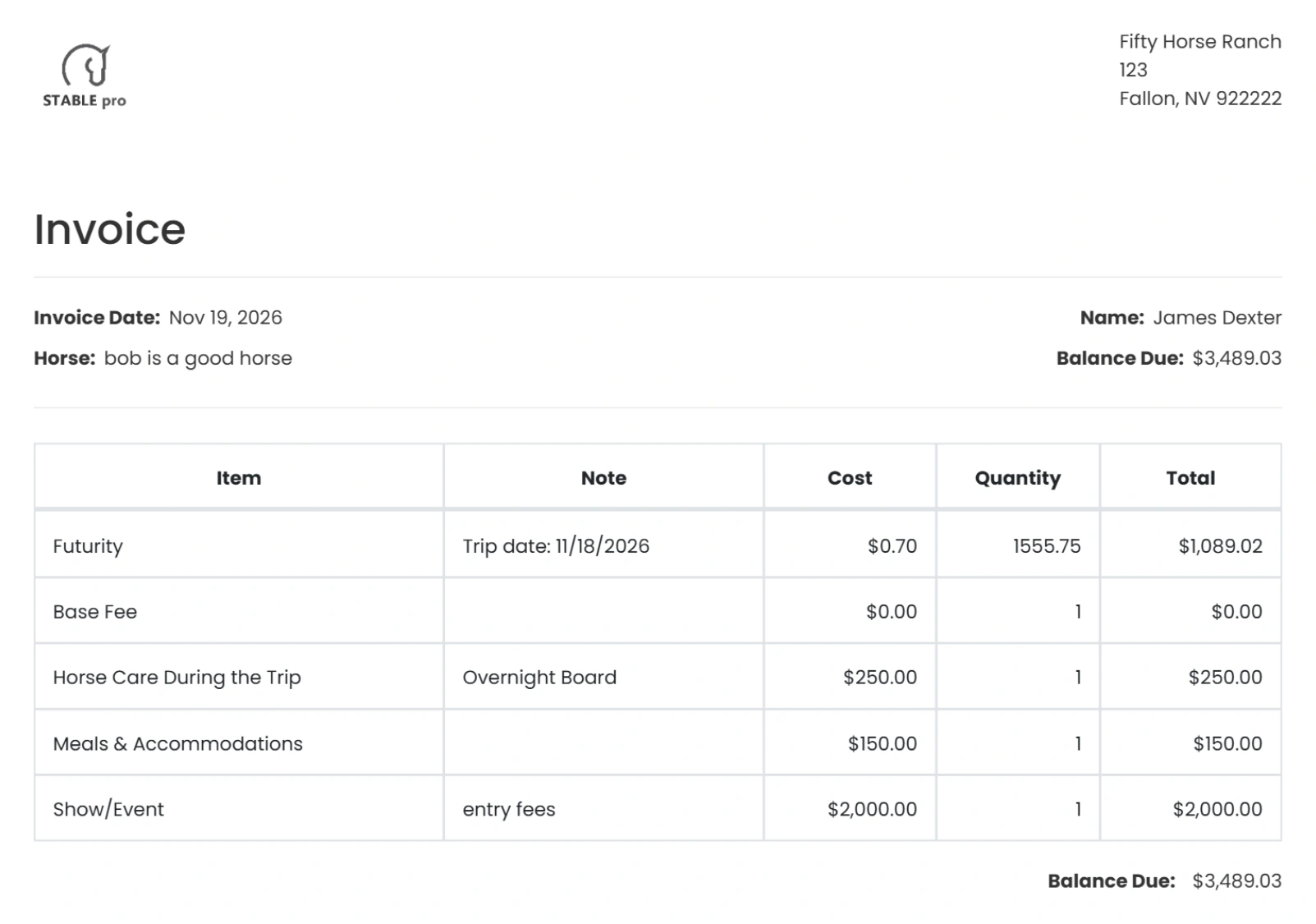
The owner can see what each charge was for and what the trip cost in total. There's nothing to guess at.
Where STABLE Pro fits
We make STABLE Pro, so read this part with that in mind.
STABLE Pro is horse accounting and barn management software, and it's built around the horse's profile. You select the horse, add the charge, and it's billed to that horse's owner automatically. That's how the right horse ends up on the right owner's bill without you sorting it out.
It invoices for board and the extras, and you can get as detailed as you like. Each charge can sit on its own line. Owners can pay their bill online.
You can connect your staff, too, and let them add anything billing related. The person who held the horse for the farrier or did the night blanketing can enter it right then. The charge doesn't depend on someone remembering to tell you at the end of the month.
You can preset a due date and a percentage late fee. STABLE Pro sends the owner a reminder the day before the bill is due, and if it isn't paid, it reissues the invoice with the late fee added.
If you teach, lessons live in the same place. Students and parents can book and cancel. You mark a lesson complete and bill it, or cancel it and decide whether the charge goes out.
Every PRO plan comes with a 2-month free trial. Take a look at stableprotech.com.
This post is general information, not legal or tax advice. Talk to your tax professional about sales tax and record keeping, and to an attorney about your contract terms.
Sources
- What to include on an invoice, Xero.
- How barns get paid on time, Stable Management. Quotes Michelle Stallings, the Lovingoods, Lynne Pomerleau and others.
- Handling Payment in the Field, EquiManagement. From the 2024 Special Issue. Quotes Amy Grice, VMD, MBA.
- How to Get Paid: Addressing Cash Flow Issues Within Equestrian Businesses, Pamela N. Saul, The Plaid Horse. July 11, 2018.
- When Clients Don't Pay, Kristin Pitzer, NRHA Pro Trainer. January 29, 2025. Quotes attorney Jordan Willette.
See it in STABLE Pro
Equine business and horse management software for professionals, equestrians and families. Explore invoicing, payments, horse records and scheduling on the official website.